
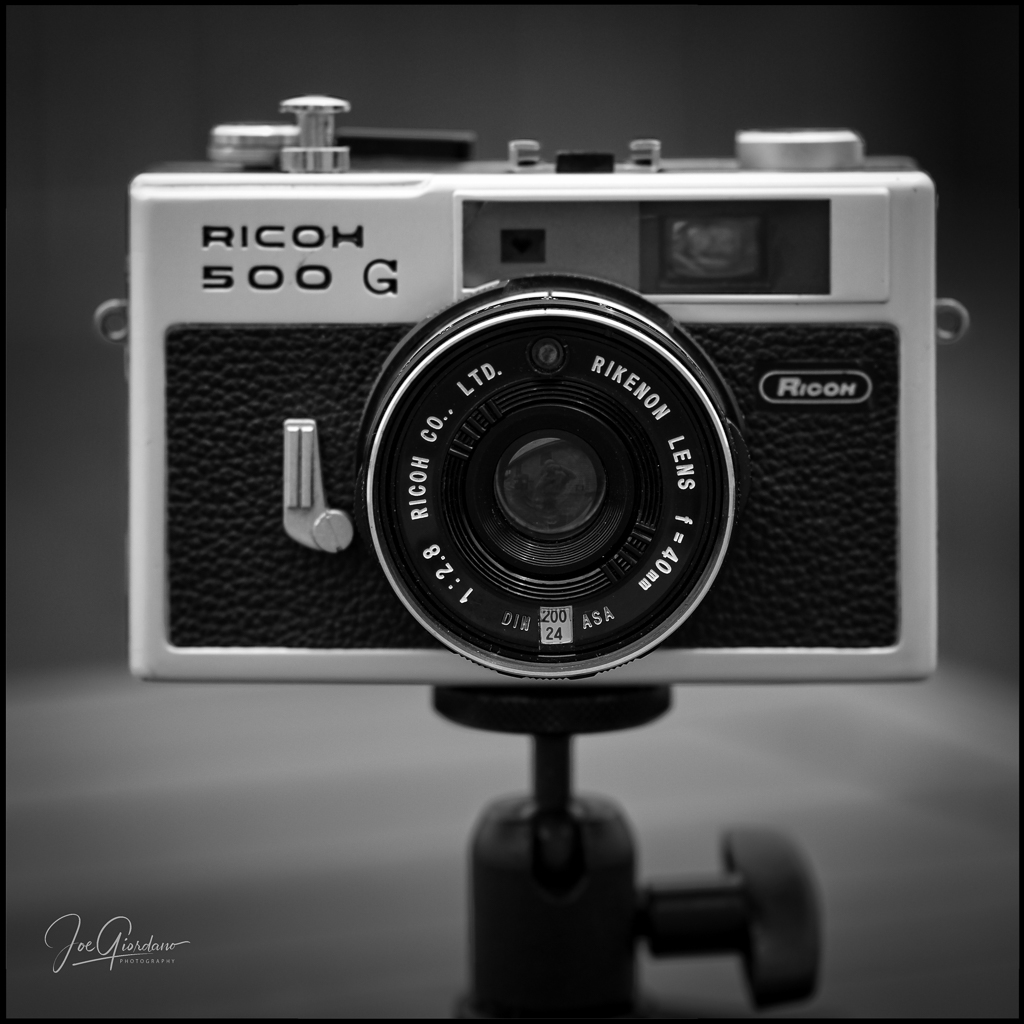
 Image was taken with a Fujifilm X-E5 and XF 50mm f/2.0 lens
This camera is sort of a dark horse in the world of 1970’s rangefinder cameras. The Ricoh 500 G is a totally mechanical camera that uses a button battery to power the light meter. The camera can also be used in shutter priority mode by placing the aperture ring in the “A” position. The really nice thing about this camera vs the previous Canon rangefinders I have posted about is that the light meter stays active in shutter priority mode and also in manual mode. On the Canon rangefinders the light meter is only active in shutter priority mode. In order to shoot in manual mode with the Canon’s you must first memorize your light meter reading while the camera is in shutter priority mode then switch to manual a make your adjustments accordingly. The Ricoh has a tack sharp 40mm f/2.8 lens. The Canon’s seem to have a more robust build quality also IMHO. For example when you open the back of the Ricoh the door feels a little flimsy compared to the Canon’s. The controls on the Ricoh are precise but you really must have small hands to work them. The focusing ring is an exception because it’s on the front of the lens barrel so it feels like you are focusing an SLR camera rather than reaching for a lever towards the rear of the lens like the Canon’s.
Now let’s talk about what I had to do to get this camera ready to load some film. As usual the light seals were crumbling and had to be replaced. The seals on this camera are fairly basic so I cut my own out of a sheet of 1.0 mm light seal foam. That job went relatively smooth except for removing the previous adhesive. I usually use 99% isopropyl alcohol and Q-tips to saturate old light seals and let them sit for about 15 minutes. This usually results in making the adhesive removal a fairly quick job. Not so with this camera. I don’t know what kind of adhesive the previous technician used when they replaced the light seals but I almost was tempted to use a pneumatic jack hammer to remove it. After soaking and scraping multiple times the camera door was ready for the new light seals. Surprisingly the shutter and aperture blades were clean and working properly so all I had to do was clean the front and rear lens elements. Next up on the agenda was to clean the rangefinder and I purposely left this step for last because unlike the Canon’s where the top skin of the camera has to be removed to access the rangefinder the Ricoh is assembled like an ice cream sandwich and the front of the camera had to be removed to then remove the top to access the rangefinder. After a little head scratching to try and figure out the most efficient way to take this camera apart it was obvious I had to peel back the faux leather to access some screws and remove a few of the rings around the lens to get the job done. After that it was time to re-assemble everything and the finished product is displayed above. Now up for sale she goes.
To view this image in color please click – here


You must be logged in to post a comment.