Taken during my December 2024 Orchestral Tour to China with the Symphonique des Bords de Loire, in Yong Zhou, Hunan Province. With one letter change, this could have been very funny…
Yong Zhou, Hunan Province — December 2024 orchestral tour with the Symphonique des Bords de Loire. Street photography on tour is opportunistic and quick: the X100F stays in your pocket, and you shoot the thing that makes you stop mid-stride. The Luckin Coffee sign needed one careful letter change to be very funny indeed. Monochrome was the obvious choice — it is, after all, a graphic image at heart. See the China series on China — How a Journey Transforms a Man on IJM Photography.
For once I used just my phone to capture this photo of Molly, aka Doggy Dog, aka Daddy’s beautiful girl, aka Gorgeous, aka Silly Billy Doggy! Conversion to black and white carried out by Snapseed.
Sometimes the best camera is the one in your pocket — Molly photographed on the phone, converted to black and white in Snapseed. Portrait photography works in monochrome because it strips the background of its colour, leaving only the quality of light on the subject and the expression. Molly’s eyes do all the work. More on IJM Photography.
Fields, dry stone walls, and sheep. I love this countryside so much. You can see this photo and more like it in my UK Chronicles series on ijmphotography.net. For those of you who are interested, shot with the X100F, edited in Lightroom.
Fields, dry stone walls, and sheep — the Northumbrian countryside with the X100F. Monochrome landscape photography is about simplifying a scene that is already simple: the tonal relationships between sky, stone, and grass are all the picture needs. The X100F’s fixed 23mm lens works well for this kind of expansive framing; you include sky rather than trying to compress the scene. See the full UK Chronicles series on IJM Photography.
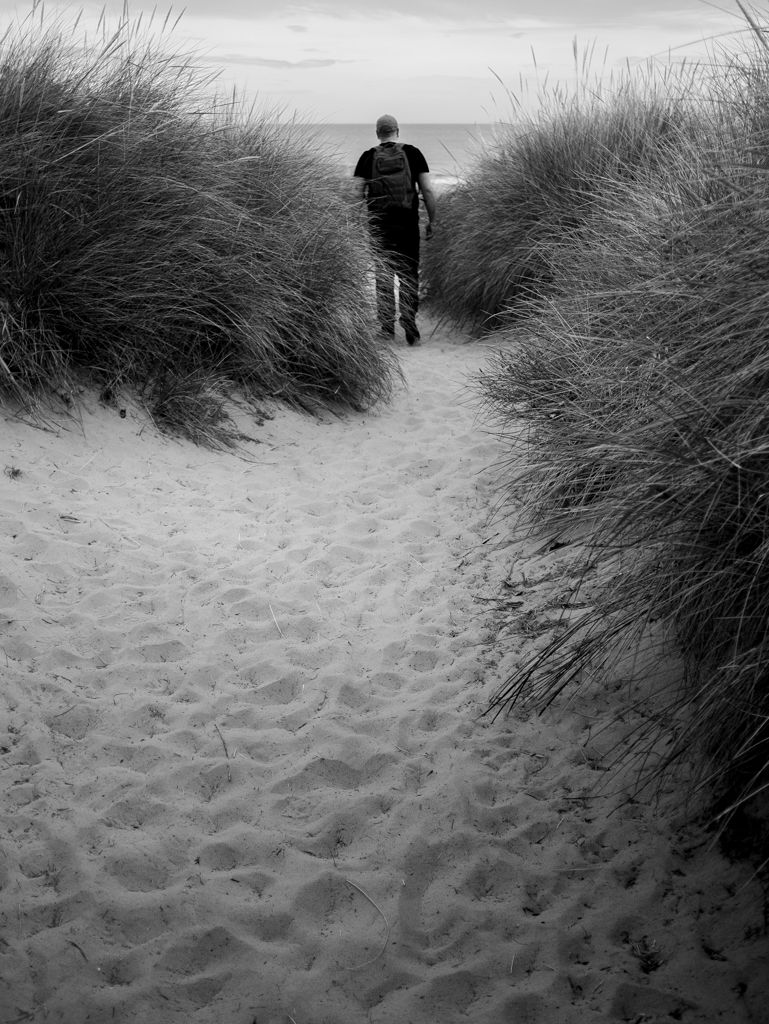
Heading onto the beach at Bamburgh with the X100F — a photograph of movement and direction rather than a formal portrait. Beach light in Northumberland is wide and even; shooting into the light at this angle silhouettes the figure against the sand and sea, and monochrome holds the tonal range from the bright sky to the foreground shadow without compromise. See the Northumbrian Summer series on IJM Photography.
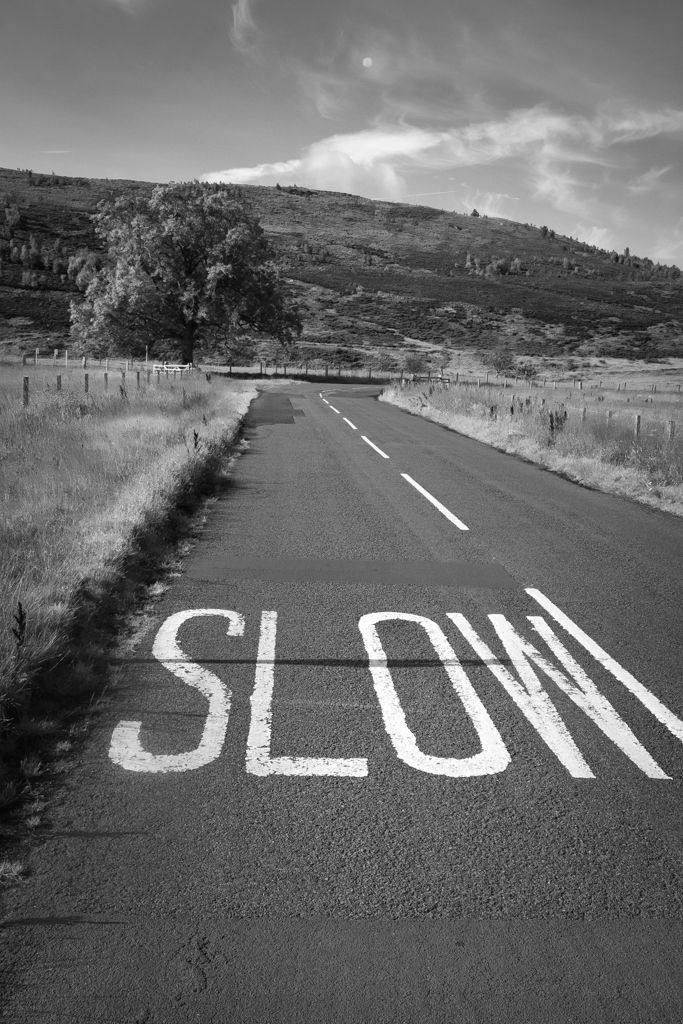
Sometimes you just have to slow down — a landscape moment with the X100F in Hepple, Northumberland. Monochrome landscape is as much about what you leave out as what you include: the colour of the heather, the orange of the bracken, stripped away to leave the structure of the land itself. See the UK Chronicles Part VI: Hepple to Otterburn on IJM Photography.
It was a good day to die. I was at peace. I was taking in the beauty of my God’s creation, and tying to capture it in some way.
I didn’t die, of course. Thank heavens! But I certainly was at peace and one with the landscape.
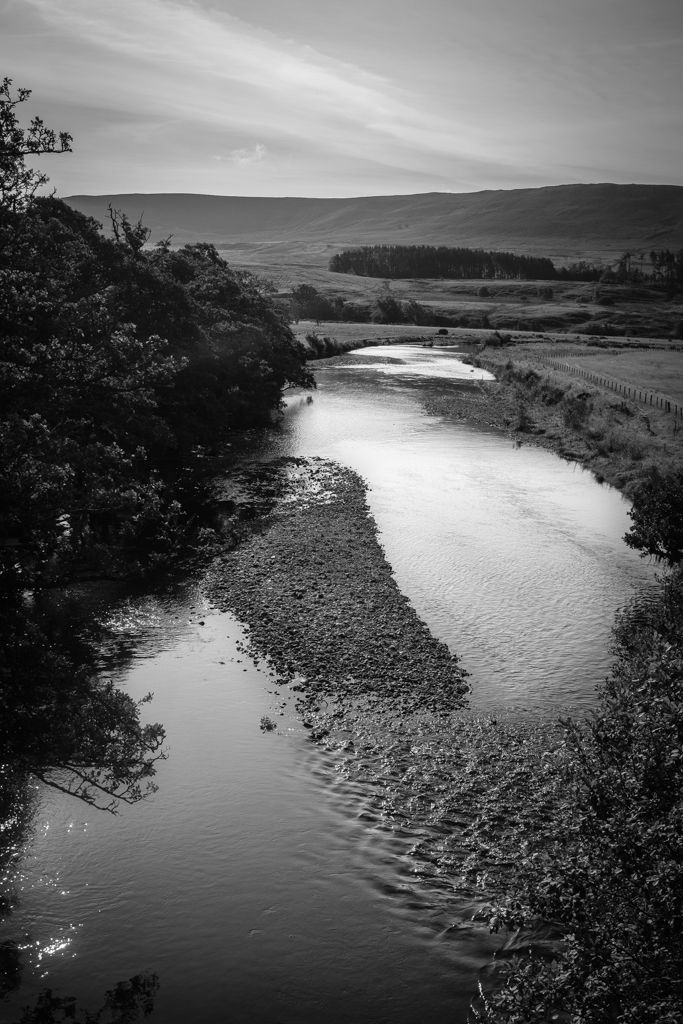
This is just outside a small village in Northumberland which is known for its gin production of all things!
You can see more from my UK Chronicles here, but be warned, I photographed everything in colour….
Just outside Hepple, Northumberland — the X100F and a good day in the hills. The X100F’s compact form is an advantage here; you can take it anywhere without the weight of commitment. Monochrome lets the gentle tonal gradation of the landscape breathe without the distraction of colour. See the UK Chronicles Part VI: Hepple to Otterburn on IJM Photography.
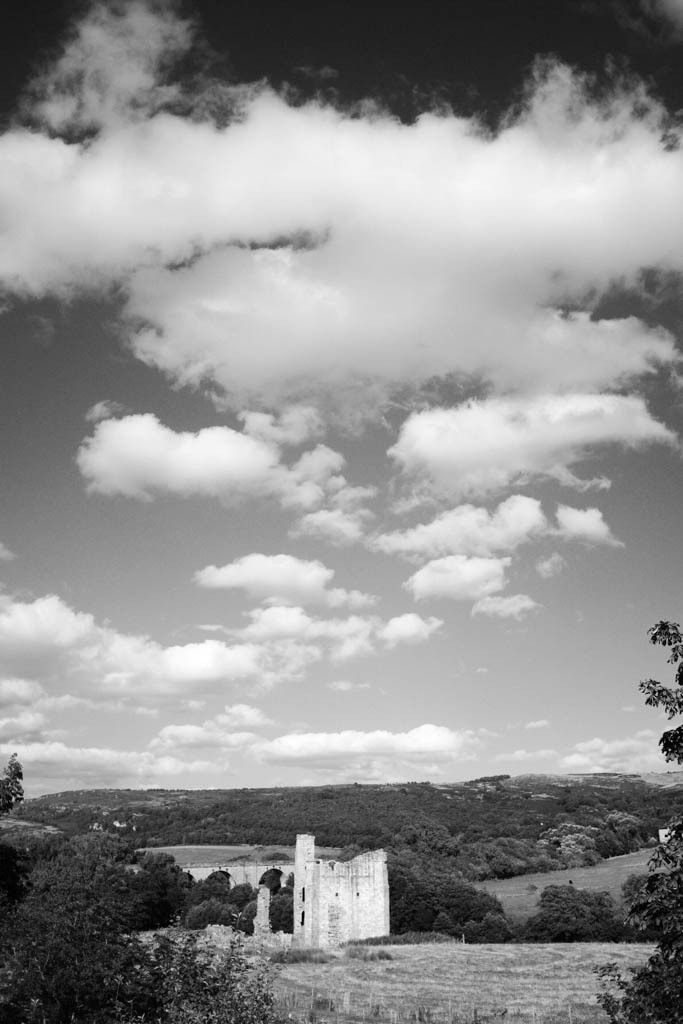
A photo from my recent trip to the UK. I was out exploring the Northumbrian countryside with my son and my X100F, and came across this castle… It was a good day.
A castle discovered while exploring Northumberland with my son and the X100F — the kind of find that justifies driving without a plan. Monochrome suits castle photography naturally: grey stone, geometric form, and sky are a tonal study without needing any conversion. The fixed focal length forces you to work for your composition rather than relying on zoom. See the UK Chronicles Part IV: Alnwick to Rothbury on IJM Photography.
I think, as photographers, we all have a fetish for a particular subject for our photos. I have a friend in Denmark that admitted to always taking shots of empty park benches. And if i’m going to be honest with you, he did it rather well.
Mine is about the quasi obligatory bike shot. Firstly in these environmentally aware time, people are wanting to reduce their carbon foot print and their impact on the environment. What better than cycling? Well it means that there are quite a few bikes around town. And it’s just something that shouts out to me. Well this photo shouted so loudly that I just had to press my shutter button.
The photo was taken in Nantes, using the Pentax ME Super (which is indeed pretty darned super) with Rollei RPX 100 black and white negative film.
And if you’re interested, have a peek into my world on IJM Photography. Who knows, you might even enjoy it.
Shot on the Pentax ME Super with Rollei RPX 100 film in Nantes. The high-contrast grain structure of the RPX 100 suits street detail beautifully — the spokes and chain become a graphic web of lines rather than just a bicycle. Metering for the mid-tones let the shadows crush naturally, reinforcing that geometry. See more from this camera on IJM Photography.
Some people see in colour, but I tend to see in black and white. I don’t know if it’s because I come from the world before digital, where “serious” photography was always monochrome. It just resonates with me more, and with you too, Dear Reader. Or at least I hope it does because in all the posts on this site there is a theme. Apparently. Subtle. But if you look closely enough, you might just find it.
Believe it or not, when I use black and white film, well, this conversion doesn’t even enter my mind. I learned to “see” in black and white while learning my craft back in the day. Nowadays we have digital cameras that can convert your image to black and white in-camera, but I still prefer doing it myself in post-production.
I just wanted to show you the differences since here we all deal in Monochrome, hence the name Monochromia. It might also help those of you who are new to black and white photography and wish to see what can be done to a colour image.
For info, the photo was given to me by a friend on Instagram asking me how I would edit her self-portrait. I don’t think I did too shabby a job.
For those of you wanting to explore black and white photography for yourselves, I would suggest buying a film camera, loading it with the black and white film of your choice, and sticking to it for a whole year. Same film, same camera. Like this, you too will start to see the beauty of black and white, and you will get to know your film stock and camera. Just an idea, and it certainly worked for me.
The conversion shown here illustrates the core principle of monochrome work: it’s not about removing colour, it’s about redistributing luminance. A dedicated black and white conversion (rather than a simple desaturate) lets you dial up contrast in specific tonal ranges — here the skin tones were pulled toward the mid-greys to give the portrait a timeless, film-like quality. Explore more techniques at IJM Photography.
Please welcome our newest guest contributor – Ian Myers
This is a photograph of the Château de la Preuille taken in 2022 on the Canon 6D Mark II, using an ND filter for the long exposure of the sky. The château was once a supplier of Muscadet white wine to Président Mieterrand. But now the wine business and château are two different entities. The château is now available for hire as an events venue and offers accommodation in the historic towers.
About Ian
A musician, a photographer, a writer, a lover of good food, with a particular weakness for a nice cup of tea and a piece of cake. Originally from the UK, but I drifted, and have been living in France for the last 30 years. The first 20 are the hardest, and then you just stop fighting it, man!
On a more serious note, I am 52, have been into photography since childhood, and things got serious in 1987 when I bought my first SLR, the Praktica MTL3, that I still have. It was what I learnt my craft with. Old School, for some, and normal for others. Digital came along, but film remained a constant. And now I do both. A camera is but a tool after all. Some do certain things better than others.
Since 2019 I have been blogging about my photographic journey, and have lately written articles about how to. More what kind of approach to have (in my opinion of course), and aiming to demystify this passion that we share, whilst drawing on 40 years experience as an amateur photographer. The ethos being something along the lines of, if I can, then you can.
The Château de la Preuille image was shot on the Canon 6D Mark II with the 16–35mm f/4 L lens and an ND filter to achieve a long exposure of the sky. Slowing the shutter to several seconds transformed the clouds into smooth sweeping streaks — the ND filter is the key tool for this effect in bright daylight. Read more about long exposure and landscape technique at IJM Photography.

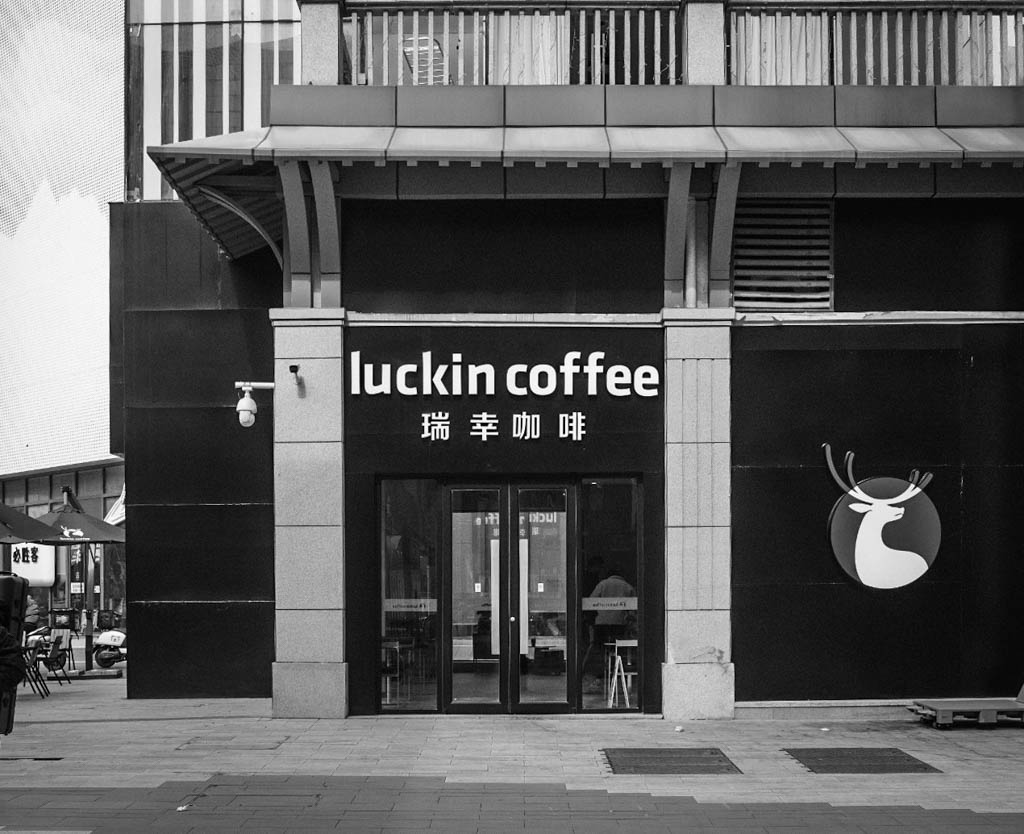 Taken during my December 2024 Orchestral Tour to China with the Symphonique des Bords de Loire, in Yong Zhou, Hunan Province. With one letter change, this could have been very funny…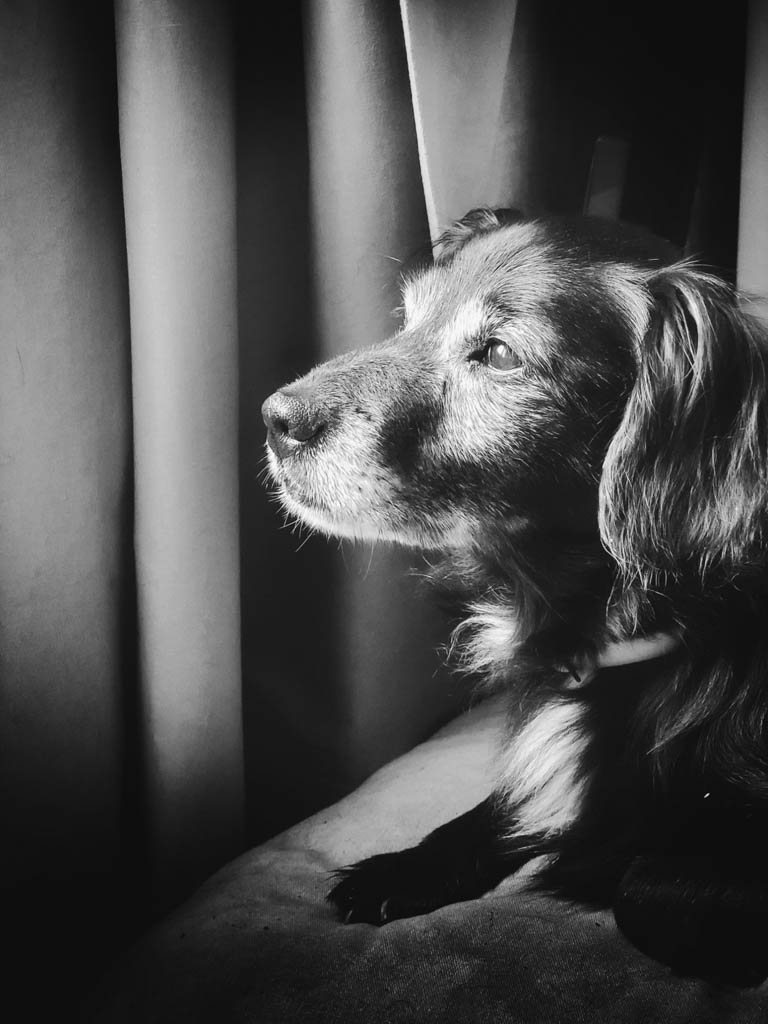

 A photo from my recent trip to the UK. I was out exploring the Northumbrian countryside with my son and my X100F, and came across this castle… It was a good day.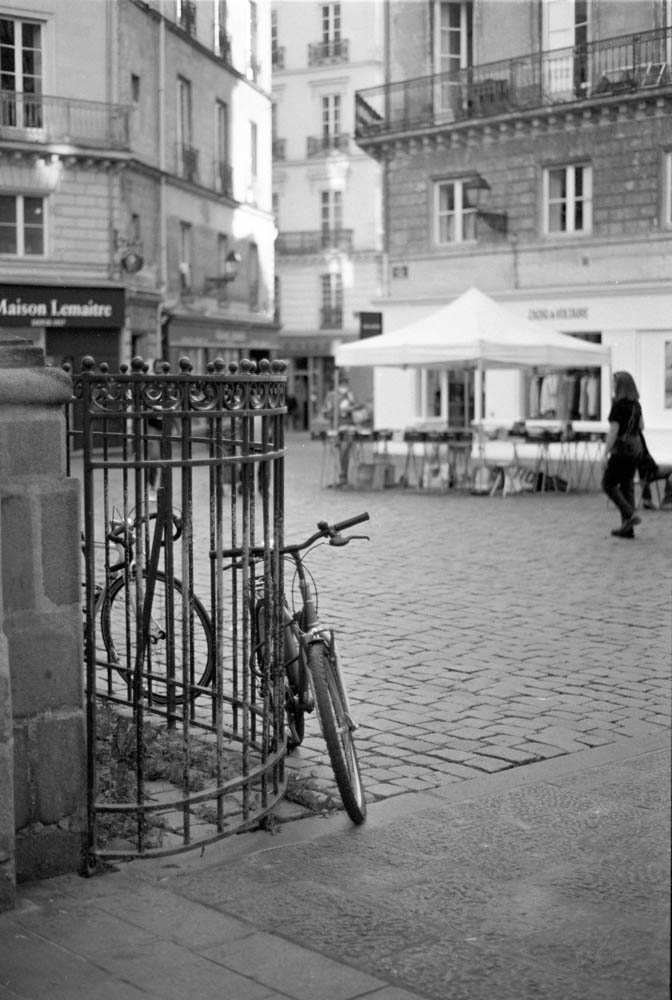


You must be logged in to post a comment.